Guard Clauses and Early Returns
Guard clauses are conditional checks placed at the top of a method or program block. They allow you to exit early when preconditions are not met, instead of nesting your core logic inside multiple IF statements.
This can make your code cleaner, flatter, and easier-to-read.
Purpose
Use guard clauses to:
-
Prevent unnecessary nesting
-
Make failure paths explicit
-
Highlight normal/expected execution flow
-
Improve maintainability
They are especially useful when multiple conditions must be satisfied before proceeding with the main logic or operation.
Key Concepts
Guard Clause: A conditional statement that exits early if a condition isn't met.
Early Return: Exiting a method before reaching the end when a precondition fails.
Fail Fast: Design principle that stops execution as soon as something goes wrong.
How-To
When writing a method or body of logic:
-
Check for invalid or exit conditions early.
-
Return immediately if a condition fails.
-
Keep the main logic flat and uncluttered.
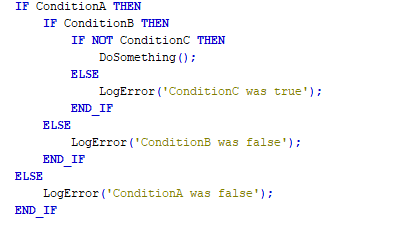
Here we can see some nested conditional logic around the DoSomething() method. This is fairly easy to read at this point but, as more conditions are added, it can quickly become difficult to read and maintain.
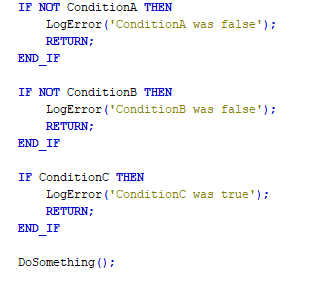
By inverting conditions and returning early, we can clean up the code and remove the nesting making it easier to follow.
Tips
Use guard clauses in methods with multiple preconditions.
Combine with interfaces for clean, testable logic separation.
Avoid overuse... if your method needs more than a few guard clauses, it might be doing too much.
Example
Clone and check out the project in examples folder!